To celebrate premature infants born at Dublin’s Rotunda Hospital and to applaud their strength and tenacity, the Rotunda Foundation hosted a party in their honour on Thursday 15th November.  All babies born in 2016 who weighed less than 1500 grams along with their parents and siblings will join together to celebrate World Prematurity Day and also to mark a successful year of “Tentacles for Tinies”, a pilot project launched by the Rotunda Hospital last year.

The Rotunda Hospital also announced the hospital’s 2017 Annual Clinical Report, which shows that in 2017 the survival rate of normal babies born premature at 28 weeks or later was 100%.

Commenting on these superb outcome results, Master of the Rotunda Hospital, Professor Fergal Malone said “I am delighted to announce these results on World Prematurity Day, which is one of the most important days in the year to raise awareness of the challenges that families face as result of a preterm birth. One of the main risk factors for preterm birth is having delivered preterm in a prior pregnancy followed by medical complications such as blood pressure problems during pregnancy or poor fetal growth. The team at the Rotunda utilizes the latest cutting edge research to optimize the early diagnosis of preterm birth, preeclampsia and fetal growth restriction. Combined with significant improvements in integrated obstetric and neonatal care, this underpins these excellent outcome results for some of our most vulnerable babies. More families than ever now have healthy surviving babies because of continued advances in obstetric and neonatal care at the Rotunda.”

Coverage of World Prematurity Day and our celebrations

RTE Radio One Drivetime

Weekend AM

Some photos from the day!


In Ireland, roughly 1 in 500 births are to babies with Down Syndrome. That is one of the highest rates in Europe. In the Rotunda Hospital, we see between 20 and 25 babies with Down Syndrome born every year. It is an important condition that affects many people and their families in Ireland we are dedicated to investing research in.

In a recent study in the Hospital that looked back at babies born with Down Syndrome over the last 5 years, we found that the majority of babies with a diagnosis of Down Syndrome ended up being admitted to the Neonatal Intensive Care Unit. The study looked at around 120 babies born with a Down Syndrome diagnosis, and found that over 80% of those babies were admitted into our Unit. You can read this study here.

Some babies were admitted straight away, after problems were diagnosed before or just after the baby was born, but the majority of cases were admitted after they had problems feeding or had a low oxygen levels in their blood.

All babies with Down Syndrome are screened for structural problems with the heart – about 50% of babies with Down Syndrome will have a structural abnormality with the heart and this needs prompt referral to our cardiology colleagues for surgical repair down the line.

The other biggest reason for a baby having low oxygen levels that we have found, other than structural heart disease, is actually the high pressure in the lungs, which is the focus of our research with these babies over the next few years.

We found that in babies with Down Syndrome, the transition whereby the blood vessels in the lungs which are usually closed up on delivery and open up slowly after birth doesn’t happen as smoothly. This is what we call pulmonary hypertension. The below video by the HRB Mother and Baby Clinical Trial Network explains what happens during this transition.

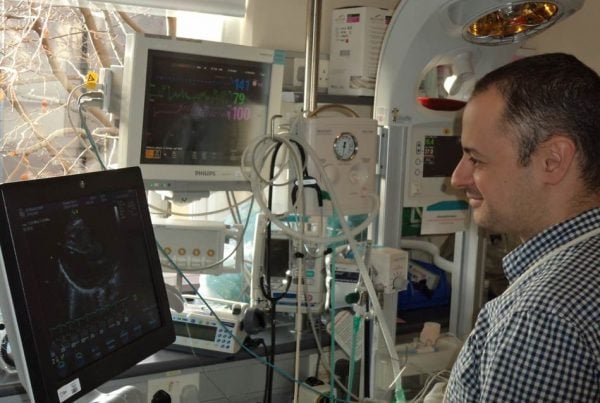
Prof Afif El-Khuffash, Consultant Neonatologist, in the Neonatal Intensive Care Unit

Prof Afif El-Khuffash, Consultant Neonatologist, in the Neonatal Intensive Care Unit

We use a technology called echocardiography, which is an ultrasound technique used to assess the function of heart muscles.

With echocardiography, we examine the right side of the heart. The right pumping chamber pumps blood into the lungs, and so we can derive what is happening in the blood vessels in the lungs from how the right side of the heart is behaving. From this, we can estimate how high the pressure in the lungs is – it should be quite low to allow blood to flow through the lungs freely, but in babies with this condition, it may be much higher than normal. We can see the right side of the heart struggling sometimes to pump blood against this high pressure in the lungs.

We were really struck by how many of these babies had pulmonary hypertension – much higher than the literature reported. Up until recently, the scientific literature showed that this is only a problem in 5% of babies, however recent research that we have published in the Rotunda has found that it can be as common as up to 50% of these babies. It is a problem that has been under-recognised.

We don’t know what happens to the pulmonary hypertension in those babies in the long run. This is one of our research endeavours.

We recently received a grant from the Health Research Board and the Children’s Medical Research Foundation which will allow us to follow all babies born with this condition in the three maternity hospitals in Dublin, and then we will call them back at 6 months, a year and 2 years, to do follow up scans.

We’re hoping to see how common the condition is, how long does it persist for, and whether it contributes to other conditions the baby may encounter over the first 2 years of life, and that would include problems with breathing and chest infections. We’re going to also see whether it is as common as we think it is. After that, we will try to target these babies and offer them treatment earlier to try to prevent the progress of the condition.

We hope that once we finish our research that we will have a strong case for pulling more resources into keeping closer follow-ups on these babies much earlier. That is the ultimate aim – To identify early and treat it early. This would hopefully reduce the incidences of hospital admittance with chest infections and reduce the complications associated with breathing and the lungs – and hopefully that will improve the quality of life for these children down the line.

The Rotunda Hospital and The Rotunda Foundation celebrated World Prematurity Day on Friday 17th of November.

Did you know, 1 in 10 babies are born prematurely? World Prematurity Day raises awareness of the challenges that premature babies and their parents go through all across the globe.

In honour of the day, the Rotunda Hospital, with the Rotunda Foundation and the Rotunda Knitters hosted a series of events to celebrate the strength and tenacity of the ‘premies’ and their parents that come through our doors.

From midnight on 17th November, as the hospital lit up in bright purple, (the colours of World Prematurity Day), the Rotunda Knitters donated gorgeous knitted gift packs to babies born in the hospital throughout the day. 


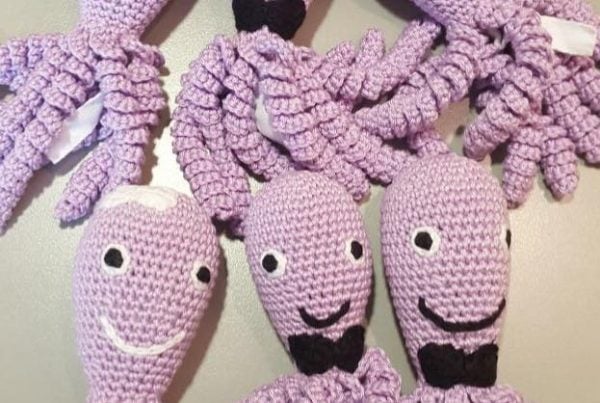
We launched our ‘Tentacles for Tinies’ initiative, which gives a crocheted octopus to babies in the NICU. The octopus tentacles replicate the umbilical cord and can comfort premature babies while they recuperate in the NICU.

You can read more about Tentacles for Tinies here.

Judy Mullane, who writes the BabyAmyAzing blog about her experiences with her Rotunda premie Amy, ran the Dublin Marathon in aid of the Rotunda NICU and raised €5000. She presented the money to Sheila Costigan, Director of the Rotunda Foundation, and Prof Afif El-Khuffash, Consultant Neonatologist, on this very important day.

To round off World Prematurity Day here in the Hospital, we invited some of our ‘NICU graduates’ from 2015 to join us in The Pillar Room, along with their mums and dads and other family members, to meet the doctors and nurses who helped them right after they were born. We showcased some of the neonatal research that the Hospital is undertaking to help provide better care and outcomes for premature babies and displayed some of the initiatives and supports we have in place for premies and their parents, like our ‘Beads of Courage’ initiative, and the Aidan and Donnachas Wings project, and our mobile intensive care unit for transporting sick infants to receive tertiary care.

These crocheted octopuses from The Rotunda Foundation and the Rotunda Knitters are helping comfort the premature babies in our Neonatal Intensive Care Unit

The tentacles of the crocheted octopus resemble the umbilical cord and remind babies of being inside the womb.

The ‘Tentacles for Tinies’ initiative is due to be launched tomorrow, on World Prematurity Day 2017.

If you would like to take part in this initiative, you can view the crochet pattern on the Rotunda Knitters Facebook page, below.

Geplaatst door Rotunda Knitters op donderdag 1 juni 2017