Breastfeeding & Lactation Support
The Rotunda Hospital recommends breastfeeding because as the best start in life for babies. We are accredited as a ‘baby friendly’ hospital – providing a high standard of care towards successful breastfeeding
The Rotunda Hospital recommends breastfeeding because as the best start in life for babies. We are accredited as a ‘baby friendly’ hospital – providing a high standard of care towards successful breastfeeding
The Rotunda Hospital promotes breastfeeding as the healthy way a woman can feed her baby. Research shows that breastfeeding can really help to start your baby off on the road to good health. The World Health Organisation (WHO) states that breastfeeding is the best form of nutrition for infants and recommends exclusive breastfeeding for the first six months of life; thereafter, infants should receive complementary foods with continued breastfeeding up to 2 years of age or beyond.
There is, however, more to breastfeeding than simply providing food. The very intimate relationship that develops between a breastfeeding mother and her baby can also help the behavioural and emotional development of the baby. During the antenatal period, the doctors and midwives will discuss breastfeeding with you and answer any questions you may have.
Our virtual antenatal breastfeeding workshops run on the first Wednesday of each month from 5pm – 6.30 pm. All women are encouraged to attend this workshop once during pregnancy from 28 weeks onwards. These sessions are in addition to the parent education classes, which all women are encouraged to attend. Early booking is advisable, as these sessions are very popular. Following on from this workshop, we invite you to attend one of our breastfeeding skills workshops, held on the second, third, and fourth Wednesday of each month. These workshops are facilitated by our lactation specialists.
If you
we would encourage you to discuss this with your midwife at your booking visit. Your midwife can advise you on how to book yourself into our classes and, if needed, book you in for a one-to-one appointment with us at our wraparound clinic. This clinic runs once a month.
If you are a public patient, please phone 01 873 0596 or 01 873 0632 to book your place.
If you are a private or semi-private patient, please phone 01 874 2115 or 01 874 0992, respectively, to book your place.
The Rotunda Hospital recommends breastfeeding because it is the best start in life for babies. The organisation implements the National Standards for Infant Feeding in Maternity Services, aiming to deliver a high standard of care so that pregnant women and new mothers receive the support they need to successfully feed their baby.
However, we support choice for women, and we will support mothers whatever decisions they make about how to feed their baby. It is not necessary to make this decision until after you have held your baby skin to skin after birth. We recommend that you take the time to discuss your options with your midwife or doctor.
You will hear lots of opinions and stories about other people’s feeding experiences. While much of the advice and information you get from friends and family will be very useful, some of it may confuse rather than guide you. We aim to give you the information you need to help you decide what is best for you and your baby.
If your baby is born prematurely or is unwell, breast milk will be a vital part of their medical treatment. You will be advised and supported by the midwives on how to establish and maintain your milk supply.
Research shows that breastfeeding has significant health benefits for mothers, including:
Less illness and hospitalisations – babies who are breastfed have a lower risk of developing some illnesses, including:
Please follow this link to watch a video by Neonatologist Dr Anne Dolan on the importance of breast milk: Why breastfeeding is important
Breast milk has all the important ingredients to build your baby’s immune system. Breast milk changes from feed to feed to suit each baby’s unique needs, making it the perfect food to promote healthy growth and development.
Breast milk contains growth factors that promote healing and repair, live cells, antibodies, and hormones that work to protect and heal your baby’s body from illness and disease. Breast milk is easily digested, and allergies to breast milk are rare.
Breast milk is free, convenient, clean, safe, and environmentally friendly; it has no waste products and leaves no carbon footprint.

Suggestions to help you prepare for breastfeeding in the antenatal period
During the first three months of pregnancy, you may have noticed breast tenderness and growth. Your breasts continue to grow during the middle three months and start to produce colostrum (first milk) between 12 and 16 weeks.
During the last three months, you may (or may not) leak drops of colostrum.
This milk is ideal for your baby for the first few days. It is made in small quantities, so your baby will feed frequently, which is perfectly normal.
Please see the link below to the HSE leaflet and video on how to express colostrum during pregnancy. If you are interested in doing this, please discuss with your HCP prior to commencing.
Please follow this HSE link below to watch a video on Antenatal harvesting of colostrum
Video link: How to do colostrum harvesting in pregnancy
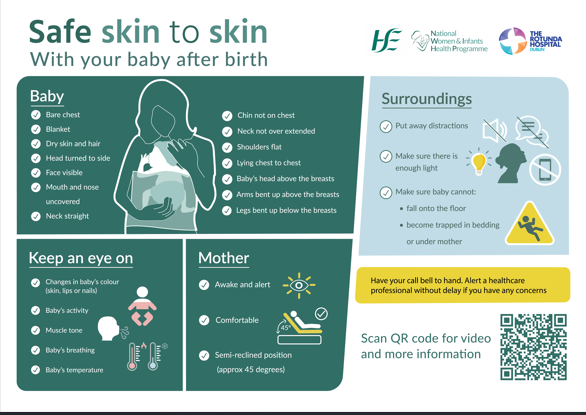
Carrying out safe skin to skin:
There is an abundant body of evidence to support the importance of safe skin to skin for both mother and baby after birth. Research has shown that healthy babies are hardwired to go through nine instinctive stages after birth during uninterrupted skin to skin. This assists them in navigating, finding, and latching to the breast. Safe skin to skin helps the baby to physiologically adapt to the world outside the womb.
Benefits for baby include:
Benefits for the mother include:
Benefits for mother and baby include:
If there is a medical reason why you cannot keep your baby in safe skin to skin contact immediately after birth, your partner can hold your baby in safe skin-to-skin contact. If you have a caesarean section under general anaesthetic, safe skin to skin contact can start when you are alert and awake. Babies that require a non-emergency transfer to the neonatal unit will be given safe skin to skin contact and an opportunity to breastfeed before transfer. Babies requiring an immediate transfer to the neonatal unit can have skin to skin contact as soon as their condition improves.
Please see the information below on how to carry out safe skin to skin contact with your newborn baby on the HSE website attached below: Skin-to-skin contact with newborns
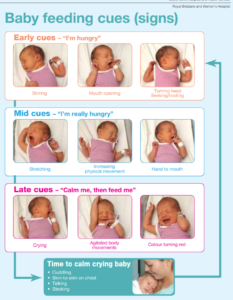
Early feeding cues;
Mid-feeding cues;
Late feeding cues;
Responding to early feeding cues allows your baby to navigate and latch to the breast in a quiet, alert state. When you see these early signs, it is a good time for you to prepare for feeding by going to the bathroom, having a glass of water at hand, and making yourself comfortable. Babies cry for lots of reasons, not just for feeding. In time, you will recognise your own baby’s signals and what they mean. Sometimes, to get your baby ready to feed, you may have to calm and comfort them first.
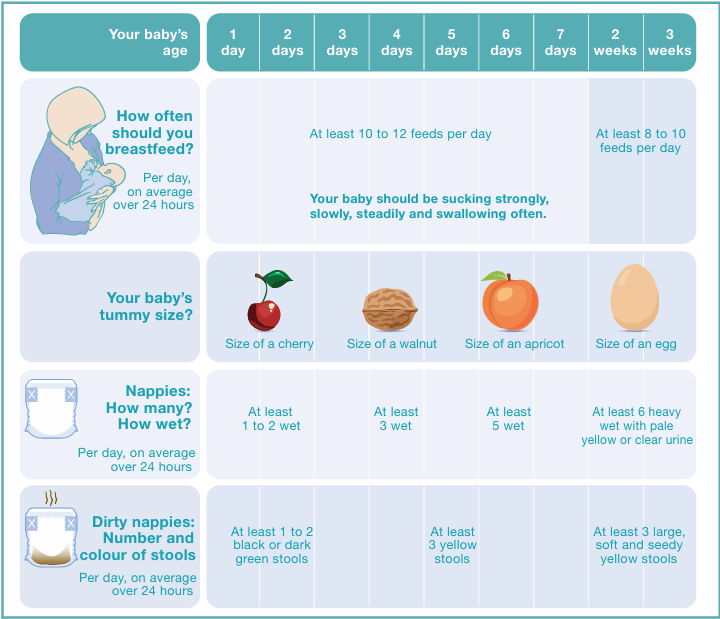
Baby-led feeding or responsive feeding means that no restrictions are placed on the frequency or duration of breastfeeding for healthy babies. If there is a medical reason why your baby needs scheduled feeding, this will be discussed with you. Your baby is likely to want to feed frequently, and it is important that your baby feeds a minimum of 8 times in 24 hours. In fact, your baby may want to feed 10 to 12 times in 24 hours; this is normal in the early days.
Putting your baby to the breast:
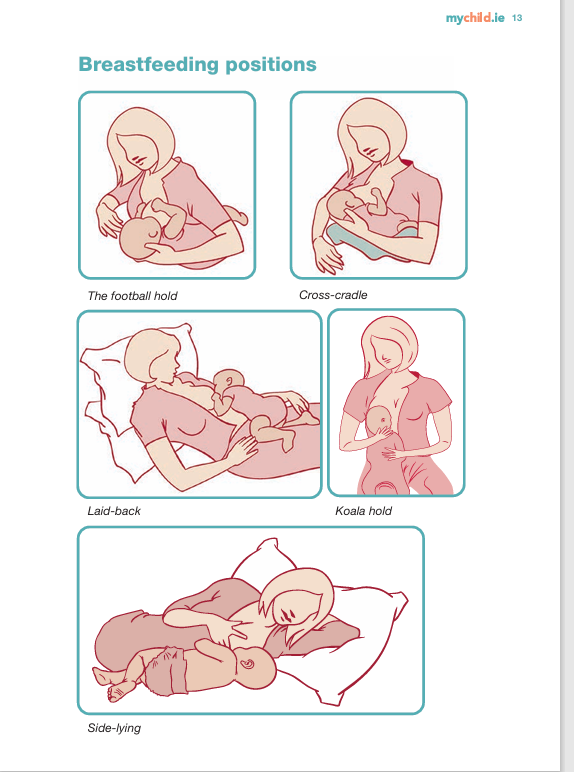
It is important that you find a position that is comfortable for you, whether you are sitting, side-lying, or in a laid-back position.
After birth, studies have shown that babies placed in safe skin-to-skin contact with their mothers can move through Nine Instinctive Stages in the first hour while transitioning from the womb to the world; Swedish researcher Ann Marie Widstrom calls this the “golden hour.”
This allows babies to elicit their innate feeding reflexes to seek and find the breast.
If you or your baby are unable to have immediate safe skin-to-skin contact, this can be carried out at any stage when you and your baby are ready.
It is always worth trying a baby-led position first, such as the laid-back position. In this position, you and your baby work together. Your baby is not fighting gravity, and uses their innate feeding reflexes to find the breast. It can be very helpful to watch Nancy Mohrbacher’s videos on this position to help you gain confidence: https://nancymohrbacher.com/blogs/news/laid-back-breastfeeding
There are various ways that you can hold your baby for breastfeeding. Whichever way you choose, here are a few guidelines to help make sure that your baby is able to feed well:
Please see HSE mychild.ie video on different positions and the end of this resource: Breastfeeding positioning and attachment (latching on)

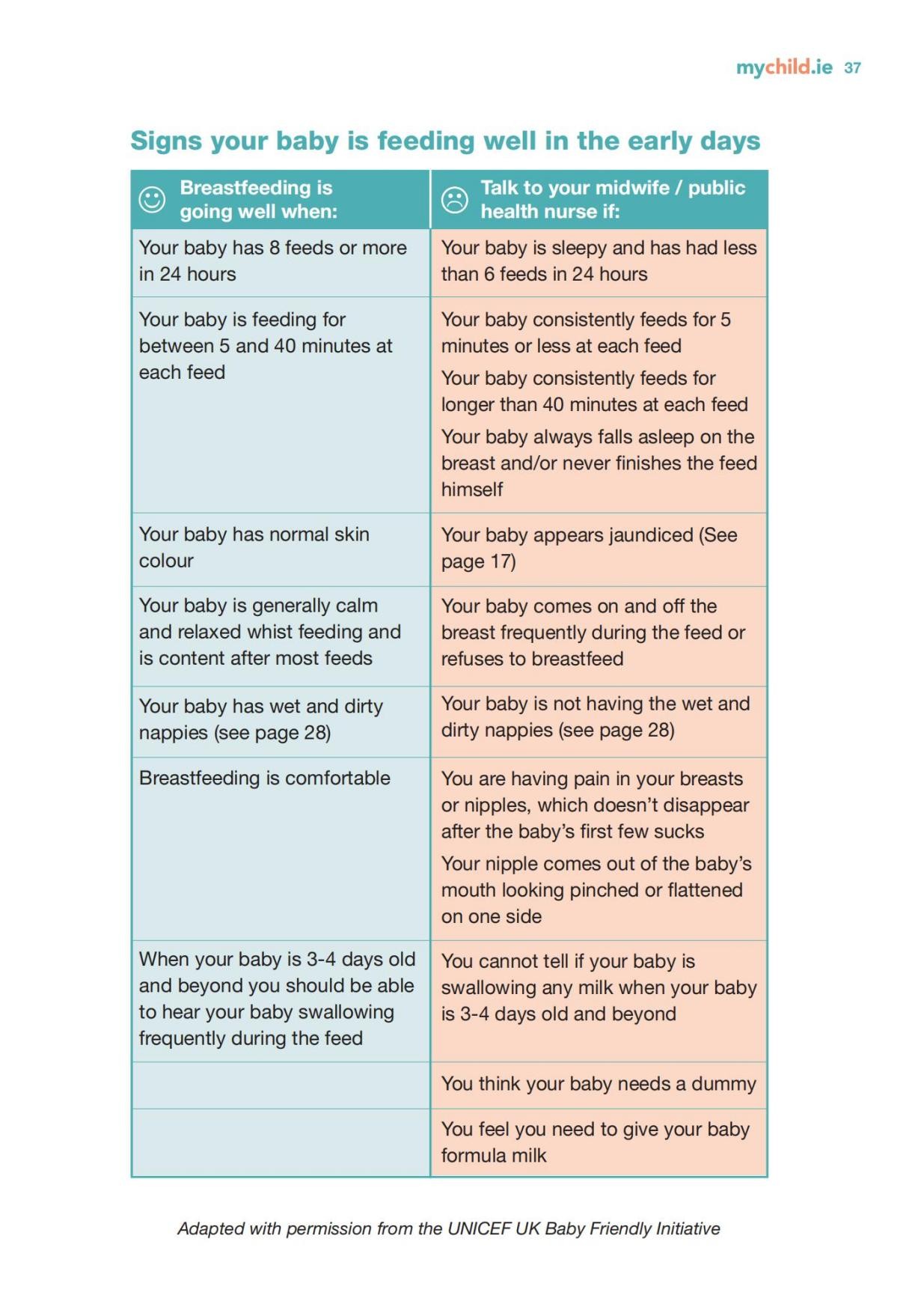
Please follow the link attached: How to tell if your newborn is getting enough breast milk
Once your baby is finished on one breast, offer them the other. This helps to build your milk supply. The more your baby feeds, the more milk you produce. If your baby is getting sleepy at the breast, you could try breast compressions to re-engage your baby before offering the other side. Please inform your midwife if your baby is not feeding well.
Tips for Successful Breastfeeding
Feeding should not be painful. If you feel some tugging when the baby first attaches to the breast, this sensation should fade quickly, and then feeding should be comfortable. If it is uncomfortable throughout the feed, this can mean that your baby is not attached properly. Gently remove the baby from the breast by placing the tip of your little finger into the side of the baby’s mouth so that the suction is broken. You can then help your baby to reattach correctly. If the pain continues, ask a midwife for help.
The midwives will assist you with breastfeeding while you are in hospital. Make sure that a midwife checks that your baby is positioned correctly and is well attached to the breast during your stay in hospital.
On the second night after birthing your baby, your baby may wake to feed very frequently; this is very normal, as they are trying to drive your milk supply, however if your baby is not settling between feeds, ask your midwife for assistance, equally if your baby is sleepy and not wakening for feeds, don’t delay in asking for assistance.
The lactation midwives are available in the hospital Monday to Friday. The midwives on the wards will contact them if special assistance is required. Once you are discharged from hospital, you may ring the lactation midwives for support by phoning 01 817 1700
Your Public Health Nurse will arrange to see you and your baby for your first visit within a few days of discharge from the hospital. Your baby will continue to feed on demand at least 10-12 times in 24 hours in the first week; this may change to at least 8-10 feeds per 24 hours from weeks 2-3 (see the previous section for signs that your baby is feeding well).
It is a great idea to link in with the resources already discussed, and attending a breastfeeding support group when you are ready will help build your confidence.
Breastfeeding information and support are also provided by:
Babies grow all the time. However, they do have growth spurts, which occur around three, eight, and 12 weeks. At this time, the baby feeds more often, and this increases your milk supply. This usually lasts for about 24 – 48 hours and then the feeding pattern returns to normal.
How to do colostrum harvesting in pregnancy
https://www2.hse.ie/babies-children/breastfeeding/tips-techniques/reverse-pressure-softening/
https://www2.hse.ie/babies-children/breastfeeding/expressing-pumping/storing-breast-milk/
For guidance and advice on expressing breast milk, please see the link: https://www2.hse.ie/babies-children/breastfeeding/expressing-pumping/how-to-express/
Flange size matters!!
Flanges (the hard plastic piece of the breast pump that is placed directly over your breast and nipple), come in lots of different shapes and sizes. It is a good idea to know the diameter of the tip of your nipple ( measured in mm’s) if you plan on using a breast pump.
Historically most pump companies’ standard sizes are too large for most women.
The Flange Fits Guide from Babies in Common is a useful resource that guides you through how to measure your nipple and obtain the flange most appropriate for you: https://www.babiesincommon.com
For guidance and advice on overcoming breastfeeding challenges, please see the link:
https://www2.hse.ie/babies-children/breastfeeding/common-challenges/engorgement/
You can have a live chat or email for advice from Ask our breastfeeding expert HSE resource
Cuidiú – Irish Childbirth Trust: www.cuidiu-ict.ie
HSE Breastfeeding Support: www.breastfeeding.ie
La Leche League Ireland: www.lalecheleagueireland.com