
Your First Antenatal Visit
At your first antenatal visit you will be seen by a midwife who will take a detailed history and assessment of your medical, surgical, obstetric and psychosocial condition.
At your first antenatal visit you will be seen by a midwife who will take a detailed history and assessment of your medical, surgical, obstetric and psychosocial condition.
At your first antenatal visit, or ‘booking visit’, you will be seen by a midwife who will take a detailed history and assessment of your medical, surgical, obstetric and psychosocial condition. Please note, a midwife may call you by phone prior to your first visit to ask your medical history.
Following a review of the history, a care plan is chosen to meet your needs after discussion with you. It’s important to contact us as early as possible when you find out you are pregnant so we can schedule your first visit with us.
In keeping with best practice guidelines we aim to see women for their booking visit between 12-14 weeks gestation; however, there is a waiting list. At this visit you will be seen by a midwife who will take a detailed history and assessment of your medical, surgical, obstetric and psychosocial condition.
Following a review of the history, a care plan is chosen to meet your needs. You are seen by a member of the medical team if further consultation is needed, to ensure the most appropriate care pathway for the pregnancy.
A baseline recording of blood pressure and a sample of urine (please provide a sample at each visit) will be taken. Blood samples are taken and a dating scan performed by an ultra-sonographer.
Women with epilepsy should book their first visit as early as possible so that they can be referred to the consultant obstetrician who will care for them during their pregnancy. Epileptic seizures can increase during pregnancy or seizures can reoccur. Your medication may need to be adjusted. A plan to reduce the possibility of seizures during pregnancy and labour will be prepared for you.
Please contact us as soon as possible when you know you are pregnant.
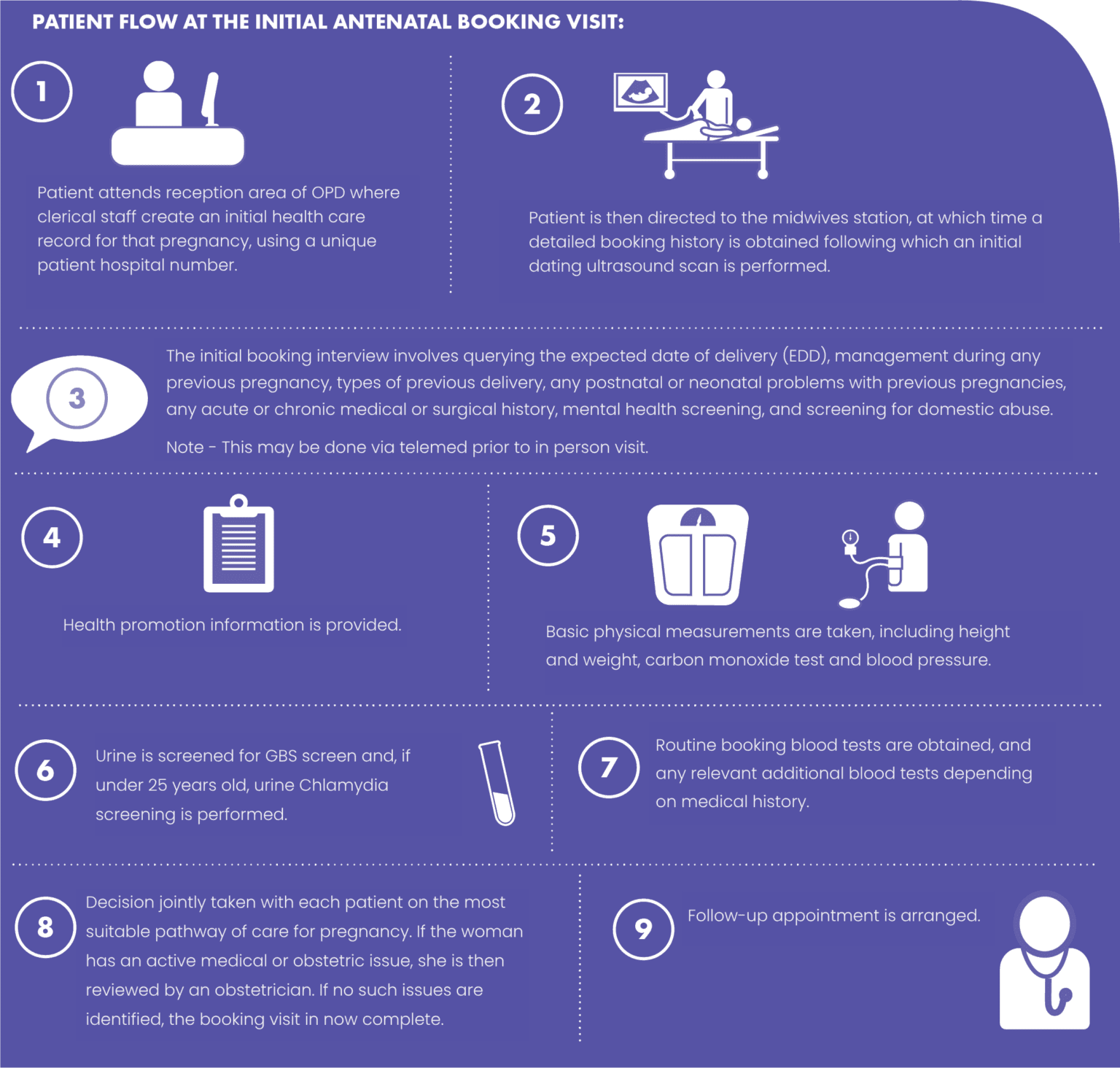
The first antenatal (or booking) visit at the hospital can take a few hours as you will meet several healthcare workers. The midwife will talk to you about your medical, surgical, obstetric and family history. You will have an ultrasound scan performed, as well as blood tests.
After you check in with the clerical staff, you will meet your midwife who will talk to you about making a plan for the months ahead. She will ask you questions about:
The midwife will talk to you about health issues such as smoking, alcohol and your diet. She will give you information and advice on eating well in pregnancy and on foods to avoid. She will also talk to you about the options of care available to you during your pregnancy and will give you information on preparing to breastfeed. The midwife will discuss any concerns or worries you may have about your pregnancy and can give you the contact details of other services or organisations that can provide additional help and support.
If you have had a complicated pregnancy in the past, or you have a medical problem, for example high blood pressure, diabetes, or a blood clotting disorder, you will be referred to the appropriate specialist doctor for the duration of your pregnancy.
Your height, weight and blood pressure will be checked as well as your urine to make sure you don’t have any infection.
Following a review of your history, a care plan, or pathway, is chosen to meet your needs.
The ‘Supported Care Pathway’ is intended for normal risk women and babies. It is delivered by the Midwives and Community Midwifery team and GP.
The ‘Assisted Care Pathway’ is intended for mothers and babies considered medium risk, this care is delivered by Obstetricians and Midwives in the hospital setting and GP.
The ‘Specialised Care Pathway’ for high-risk mothers and babies is led by the Obstetric team and involves midwives as part of a multidisciplinary team. Care will, in the main, be provided in the hospital and may include your G.P.
A woman may need to transfer, either temporarily or permanently between care pathways if an emerging risk is found.
In order to continue to provide the best service we can, we ask two things:
With your consent several blood tests are taken. These blood tests will:
Please be aware that results will not be given over the phone.
Urine Tests
Your urine is checked at every antenatal visit. The two main tests are for protein and glucose (sugar). Checking protein levels in late pregnancy is very important as it can be a sign of the condition called pre-eclampsia.
Glucose in your urine may be a concern as it could mean that you are developing pregnancy-related diabetes. If you are found to have glucose in your urine, the midwife will ask you if you were fasting when you gave the sample. If not, she will ask you to return to the hospital the following day with a fasting sample. If this sample is negative for glucose, no action is taken.
If, however, there is still glucose present, the midwife will ask that you have further blood tests to see if you have developed pregnancy-related diabetes. If you have, you will be referred to the diabetic team.
Blood Pressure
Checking and recording your blood pressure at the first visit is important.
This first reading is used as a ‘baseline reading’. Every time your blood pressure is checked after that, it is compared to this reading. If your blood pressure rises it could be a sign of pre-eclampsia which needs to be monitored carefully.
Weight check
If you are of average height and weight, you can expect to gain about 10 – 15 kg (20 – 30 lbs) during the pregnancy. The only time that you are weighed is at your first visit, unless you are attending the diabetic or anaesthetic clinics.
It is essential that you eat well and stick to a healthy balanced diet made up of carbohydrates, proteins, fats, vitamins and minerals. Your baby is totally dependent on you for its supply of nourishment in order to grow and develop. You can attend an online class with dietetics – https://rotunda.ie/nutrition/
Group B Streptococcus Information Leaflet
To ensure that women with support needs, such as reduced hearing, eyesight, movement or speaking skills, have an equal opportunity to benefit from maternity care, a variety of facilities are available, such as:
If you have a support need and you need any help, please ask a member of staff who will be pleased to help. With your permission we can record your specific needs in your healthcare record so that staff are aware of the support you need during your time in the hospital.
The Access Officer in the hospital will work with staff to ensure you can easily access the services you require