
Breast Feeding The Early Days
Carrying out safe skin to skin:
There is an abundant body of evidence to support the importance of safe skin to skin for both mother and baby after birth. Research has shown that healthy babies are hardwired to go through nine instinctive stages after birth during uninterrupted skin to skin. This assists them in navigating, finding, and latching to the breast. Safe skin to skin helps the baby to physiologically adapt to the world outside the womb.
Benefits for baby include:
- Regulates body temperature
- Stabilises heart rate and breathing
- Stabilises baby’s blood sugars
- Builds babies’ immune systems
- Reduces crying
Benefits for the mother include:
- Release of oxytocin-promoting bonding and protective maternal instincts
- Lower stress and anxiety
- Oxytocin also causes the uterus to contract, reducing the risk of postpartum haemorrhage.
Benefits for mother and baby include:
- Boosts breastfeeding success and bonding
If there is a medical reason why you cannot keep your baby in safe skin to skin contact immediately after birth, your partner can hold your baby in safe skin-to-skin contact. If you have a caesarean section under general anaesthetic, safe skin to skin contact can start when you are alert and awake. Babies that require a non-emergency transfer to the neonatal unit will be given safe skin to skin contact and an opportunity to breastfeed before transfer. Babies requiring an immediate transfer to the neonatal unit can have skin to skin contact as soon as their condition improves.
Please see the information below on how to carry out safe skin to skin contact with your newborn baby on the HSE website attached below: Skin-to-skin contact with newborns
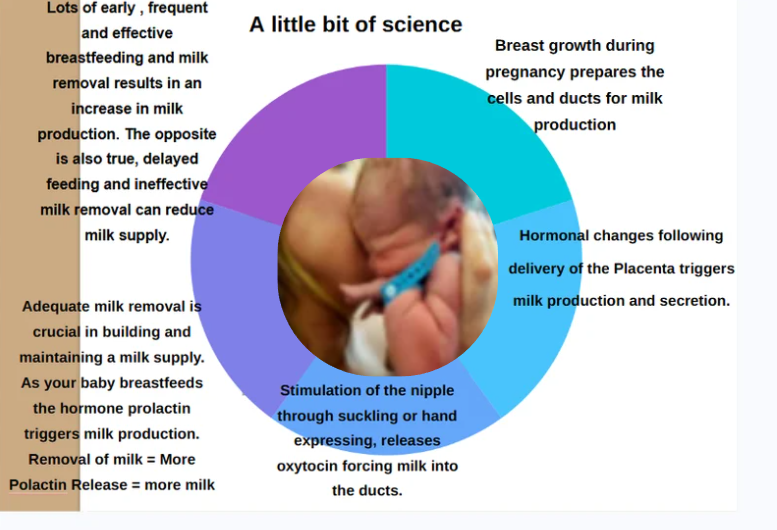
Signs your baby wants to breastfeed
Early feeding cues;
- Eyes are fluttering.
- Baby is stirring.
- Mouth opening.
- Turns its head, looking for the breast-seeking/rooting.
Mid-feeding cues;
- Stretching
- Increases in physical movement.
- Hand to mouth.
- Opens its mouth and puts out its tongue
Late feeding cues;
- Crying
- Agitated body movements.
Responding to early feeding cues allows your baby to navigate and latch to the breast in a quiet, alert state. When you see these early signs, it is a good time for you to prepare for feeding by going to the bathroom, having a glass of water at hand, and making yourself comfortable. Babies cry for lots of reasons, not just for feeding. In time, you will recognise your own baby’s signals and what they mean. Sometimes, to get your baby ready to feed, you may have to calm and comfort them first.
Baby-led feeding or responsive feeding means that no restrictions are placed on the frequency or duration of breastfeeding for healthy babies. If there is a medical reason why your baby needs scheduled feeding, this will be discussed with you. Your baby is likely to want to feed frequently, and it is important that your baby feeds a minimum of 8 times in 24 hours. In fact, your baby may want to feed 10 to 12 times in 24 hours; this is normal in the early days.
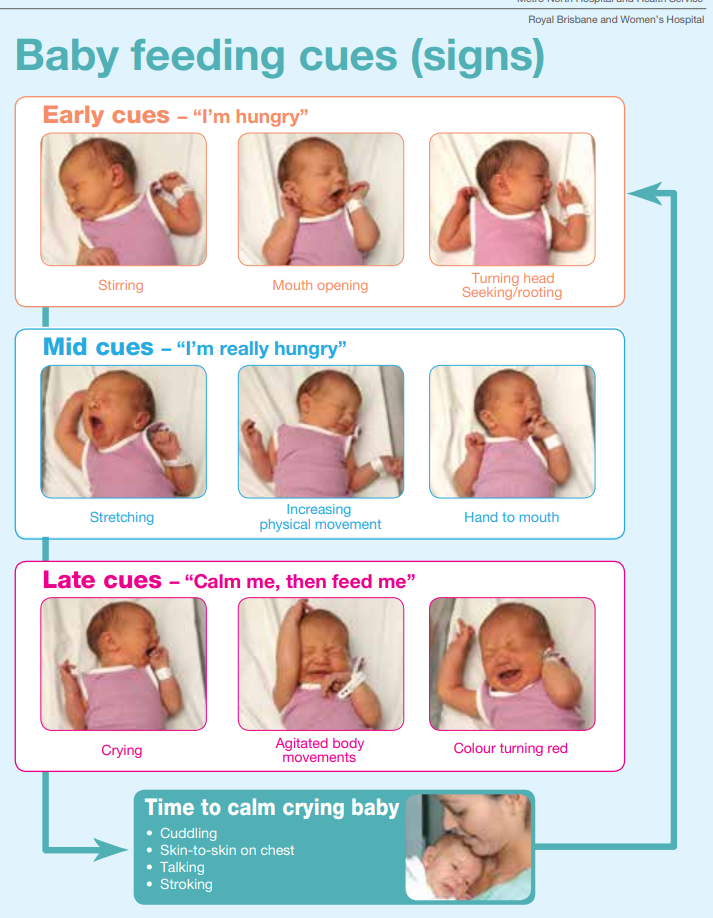
How breastfeeding works
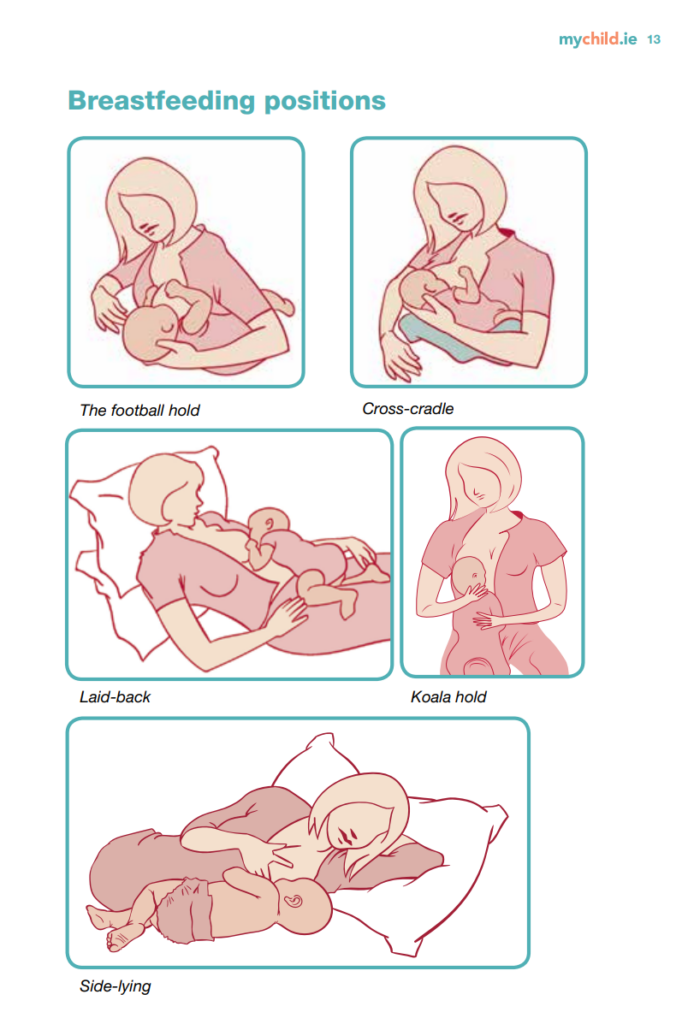
Read more on positioning and attachment
Putting your baby to the breast
It is important that you find a position that is comfortable for you, whether you are sitting, side-lying, or in a laid-back position.
Your baby’s position
After birth, studies have shown that babies placed in safe skin-to-skin contact with their mothers can move through Nine Instinctive Stages in the first hour while transitioning from the womb to the world; Swedish researcher Ann Marie Widstrom calls this the “golden hour.”
This allows babies to elicit their innate feeding reflexes to seek and find the breast. If you or your baby are unable to have immediate safe skin-to-skin contact, this can be carried out at any stage when you and your baby are ready.
It is always worth trying a baby-led position first, such as the laid-back position. In this position, you and your baby work together. Your baby is not fighting gravity, and uses their innate feeding reflexes to find the breast. It can be very helpful to watch Nancy Mohrbacher’s videos on this position to help you gain confidence: https://nancymohrbacher.com/blogs/news/laid-back-breastfeeding
There are various ways that you can hold your baby for breastfeeding. Whichever way you choose, here are a few guidelines to help make sure that your baby is able to feed well:
- Hold your baby close to you.
- Baby should be facing the breast, with its head, shoulders, and body in a straight line.
- Baby’s chin touches the breast
- Baby’s nose or top lip should be opposite the nipple.
- Baby should be able to reach the breast easily.
- Remember always to move your baby towards the breast rather than moving your breast towardsthe baby.
- Your baby’s mouth is wide open, and they have taken a big mouthful of breast
- Your baby’s bottom lip is curled back- there is no need to check the bottom lip if feeding is comfortable.
- Feeding should not hurt
- If you can see any of the areola (the brown skin around the nipple) more should be visible above the baby’s top lip than below its bottom
- Your baby’s sucking pattern will change from short sucks to long, slow, deep bursts of sucking and swallowing.
Please see HSE mychild.ie video and resources
- Breastfeeding positioning and attachment (latching on)
- HSE mychild.ie (Breastfeeding a good start in life).
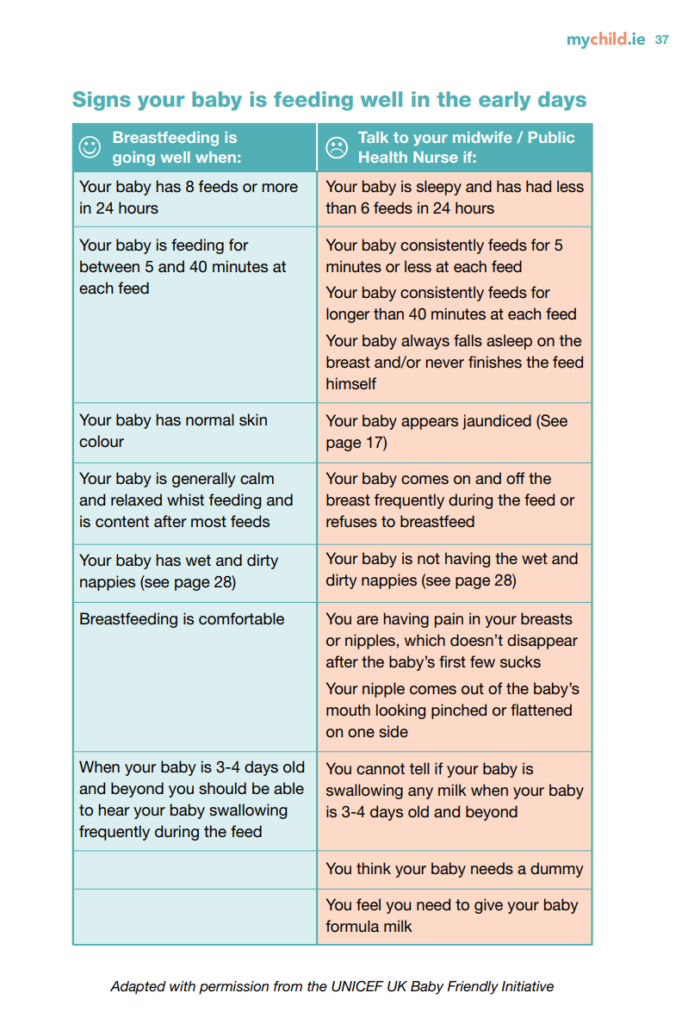
Signs that the baby is feeding well:
Please follow the link attached: How to tell if your newborn is getting enough breast milk
- Their mouth is wide open; their chin is touching your breast, and they have a good mouthful of breast.
- Their cheeks are full and rounded; both cheeks are touching the breast.
- Their jaw is moving up near their ears.
- They start with short sucks, then change to long, deep sucks with
- You should hear swallowing, not smacking or clicking You may not hear swallowing until approximately day 3 but look for visible swallows.
- Please see the link to Kathryn Stagg (ibclc) Reel: Deep latch, 3 day old baby breastfeeding effectively with lovely audible swallows – YouTube
- Baby should appear alert when awake and be able to settle and sleep at some point during each 24 hours.
- Baby should wake regularly for feeds, feeding at least 10-12 times in 24 hours in the early days.
- Baby should be satisfied and content after feeds.
- They are having plenty of wet and dirty nappies –please see the illustration below for guidance.
- Your breasts feel softer after a feed.
Once your baby is finished on one breast, offer them the other. This helps to build your milk supply. The more your baby feeds, the more milk you produce. If your baby is getting sleepy at the breast, you could try breast compressions to re-engage your baby before offering the other side. Please inform your midwife if your baby is not feeding well.

Tips for Successful Breastfeeding
- Safe skin to skin contact provides a great opportunity for your baby to access the breast and can also enhance your milk supply.
- ‘Rooming-in’ is hospital policy. This means that you keep your baby near you throughout your stay in hospital so that you can get to know your baby and their feeding cues.
- Good positioning and attachment.
- Seek support and assistance from your Midwife/PHN/GP/voluntary breast-feeding support groups.
- Visit mychild.ie “Ask Our Expert” where you can email any questions you have about breastfeeding to their online lactation consultants (IBCLC’S). Alternatively you can chat online with the lactation consultants using the webchat facility.
- Understanding normal baby behaviour and “The fourth trimester”.
Feeding should not be painful. If you feel some tugging when the baby first attaches to the breast, this sensation should fade quickly, and then feeding should be comfortable. If it is uncomfortable throughout the feed, this can mean that your baby is not attached properly. Gently remove the baby from the breast by placing the tip of your little finger into the side of the baby’s mouth so that the suction is broken. You can then help your baby to reattach correctly. If the pain continues, ask a midwife for help.
Breastfeeding support while in hospital
The midwives will assist you with breastfeeding while you are in hospital. Make sure that a midwife checks that your baby is positioned correctly and is well attached to the breast during your stay in hospital. On the second night after birthing your baby, your baby may wake to feed very frequently; this is very normal, as they are trying to drive your milk supply. The lactation midwives are available in the hospital Monday to Friday. The midwives on the wards will contact them if special assistance is required. Once you are discharged from hospital, you may ring the lactation midwives for support by phoning 01 817 1700
Continuing to breastfeed
Your Public Health Nurse will arrange to see you and your baby for your first visit within a few days of discharge from the hospital. Your baby will continue to feed on demand at least 10-12 times in 24 hours in the first week; this may change to at least 8-10 feeds per 24 hours from weeks 2-3 ( see the previous page for signs that your baby is feeding well). It is a great idea to link in with the resources already discussed, and attending a breastfeeding support group when you are ready will help build your confidence.
Breastfeeding information and support are also provided by:
- Health Services- your midwife, public health nurse, lactation consultant, practice nurse, or GP.
- La Leche League of Ireland
- Cuidiú
- Friends of Breastfeeding
- Association of Lactation Consultants Ireland
Babies grow all the time. However, they do have growth spurts, which occur around three, eight, and 12 weeks. At this time, the baby feeds more often, and this increases your milk supply. This usually lasts for about 24 – 48 hours and then the feeding pattern returns to normal.
Expressing breast milk:
- As previously discussed, you may be a suitable candidate for antenatal harvesting of colostrum.
How to do colostrum harvesting in pregnancy
- You may wish to hand express a few drops of colostrum pre-feed to attract the baby to the breast.
- You may wish to hand express pre-feed to give your baby some colostrum for energy to engage in breastfeeding.
- If your breasts are very full or engorged and your baby cannot achieve a deep, comfortable latch, hand-expressing just enough to soften the areola can help your baby achieve a deeper, pain-free latch. https://www2.hse.ie/babies-children/breastfeeding/tips-techniques/reverse-pressure-softening/
- If your baby is born prematurely or is too ill to feed from the breast, your nurse or midwife will help and advise you on how to express and store your milk. Please read https://www2.hse.ie/babies-children/breastfeeding/a-good-start/breastfeeding-your-premature-or-ill-baby//
- If you need to be separated from your baby for an appointment or an event after the first few weeks, expressing by hand or using a breast pump may be helpful. Please see the HSE link on the storage of breast milk: https://www2.hse.ie/babies-children/breastfeeding/expressing-pumping/storing-breast-milk/
- For guidance and advice on expressing breast milk, please see the link: https://www2.hse.ie/babies-children/breastfeeding/expressing-pumping/how-to-express/
Flange size matters
Flanges (the hard plastic piece of the breast pump that is placed directly over your breast and nipple), come in lots of different shapes and sizes. It is a good idea to know the diameter of the tip of your nipple ( measured in mm’s) if you plan on using a breast pump. Historicaly most pump companies’ standard sizes are too large for most women. The Flange Fits Guide from Babies in Common is a useful resource that guides you through how to measure your nipple and obtain the flange most appropriate for you: https://www.babiesincommon.com
Breastfeeding challenges:
For guidance and advice on overcoming breastfeeding challenges, please see the link: https://www2.hse.ie/babies-children/breastfeeding/common-challenges/engorgement/
Links and Resources
- HNP00367_Breastfeeding_A_Good_Start_2025_New_Web.pdf
- https://www.healthpromotion.ie/media/documents/HNP00972_Premature_Breastfeeding_booklet_Web.pdf
- https://www2.hse.ie?babies-children/pregnancy-child-books/
- How to do colostrum harvesting in pregnancy
- Skin-to-skin contact with newborns
- https://nancymohrbacher.com/blogs/news/laid-back-breastfeeding
- Kathryn Stagg (ibclc)Reel: Deep latch, 3 day old baby breastfeeding effectively with lovely audible swallows – YouTube
- https://www2.hse.ie/babies-children/breastfeeding/common-challenges/engorgement/
- https://www2.hse.ie/babies-children/breastfeeding/tips-techniques/reverse-pressure-softening/
- https://www.babiesincommon.com
Supports: