
You are being invited to take part in a research study to be carried out at the Rotunda Hospital by Professor Brian Cleary. Before you decide whether or not you wish to take part, you should read the information provided below carefully and, if you wish, discuss it with your family, friends or GP (doctor). Take time to ask questions – don’t feel rushed and don’t feel under pressure to make a quick decision .
You should clearly understand the risks and benefits of taking part in this study so that you can make a decision that is right for you. This process is known as ‘Informed Consent’.
You don’t have to take part in this study. If you decide not to take part it won’t affect your future medical care.
You can change your mind about taking part in the study any time you like. Even if the study has started, you can still opt out. You don’t have to give us a reason. If you do opt out, after the point of care test has been performed, rest assured it won’t affect the quality of treatment you get in the future. Your information and your baby’s information will not be used as part of the study.
Why is this study being done? |
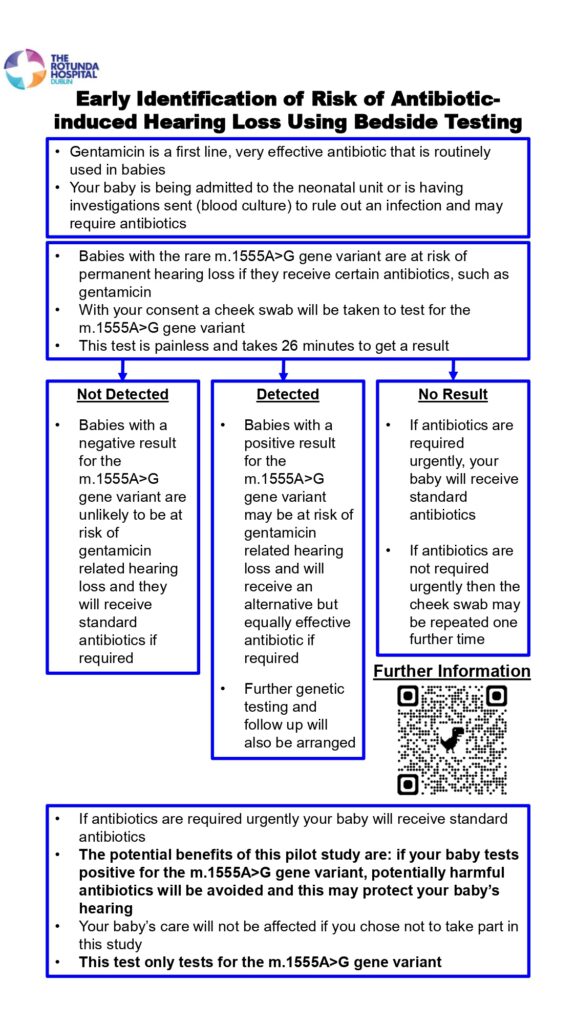
A small number of babies are at risk of hearing loss if they receive a certain antibiotic (gentamicin). This is because of a change in their DNA. We are collecting information to assess the feasibility of using a new rapid genetic test to identify babies at risk of this antibiotic related hearing loss. This involves a cheek swab test (similar to an antigen test). If the test shows that your baby may be at risk then an alternative but equally effective antibiotic will be used if antibiotics are needed and a blood test will be sent to confirm if your baby is truly at risk.
Gentamicin is an antibiotic given to all babies admitted to neonatal units with suspected infection.
In other countries (UK) they have found that approximately 1 in 400 babies have a genetic change that means they may suffer permanent hearing loss after a single dose of gentamicin. We do not know how many babies in Ireland are at risk of this and we do not know how well the rapid test (known as the genedrive test) works in our population. Testing for this genetic change usually takes weeks through a genetics laboratory, which is not quick enough for babies with suspected infection.
The rapid test (genedrive test) takes 26 minutes and was successfully tested in a large UK study (PALOH) in 2022.
The current Rotunda study will not be large enough to give us a true estimate of how common this genetic change is in Ireland but it will show us if using this test as part of care is feasible.
Who is organising and funding this study? |
This study is organised through the Rotunda Hospital and is funded by the Rotunda Foundation Charlotte Stoker Fund. The Charlotte Stoker Fund was established in 2024 and is dedicated to research on potentially preventable deafness in vulnerable newborns.
Why am I being asked to take part? |
You are being asked to take part in this study as your baby is being admitted to the neonatal unit or is having investigations sent (a blood culture) to out rule an infection and therefore may require antibiotics.
How will the study be carried out? |
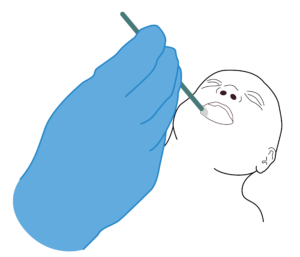
If you agree to your baby having this rapid test, a cheek swab will be taken and tested using the rapid test (genedrive). This gives a result in 26 minutes. There are three possible outcomes for each test.
- Negative result: This shows your baby is unlikely to be at risk of antibiotic related hearing loss and your baby will receive our standard antibiotics if required.
- Positive result: This shows your baby may be at risk of antibiotic related hearing loss and your baby will receive an alternative but equally effective antibiotic if required. A genetic blood test (m.1555A>G change in the MT-RNR1 gene) will be arranged to check if the rapid test result was correct (a true positive) or incorrect (a false positive). Follow up with our team (Professor Hayes) for results will be arranged on discharge. We will invite you to attend outpatients to discuss the results of the genetics blood test and arrange a referral to audiology services. More information for families who are conformed to carry the m.1555A>G gene change
- No test result: If antibiotics are required urgently, your baby will receive standard antibiotics. If antibiotics are not required urgently then the genetest may be repeated one further time.
What will happen to me if I agree to take part? |
If you agree to take part in this study, a cheek swab will be taken on your baby on their arrival in the neonatal unit. This will take 26 minutes to process. Once the result is available, antibiotics will be given if they are required. Whether or not gentamicin is given will depend on the test result as outlined above. If your baby tests negative, then care will be routine but information that is already routinely collected (e.g. time to antibiotics) will be collected. If your baby tests positive on the rapid genetest then as outlined above alternative but equally effective antibiotics will be given as needed and a genetic blood test (looking for m.1555A>G change in the MT-RNR1) will be taken from your baby prior to discharge. This is to check if the rapid genetest result is correct (a true positive) or incorrect (a false positive). You will be invited to attend the paediatric outpatients with Prof Hayes to discuss the results of this blood test.
If your baby is unwell and antibiotics are required urgently the genetest may not be performed. This is to ensure that there is no unwarranted delay in time to antibiotics being given.
Routinely collected information e.g. time to antibiotics, and baseline demographics and details of genedrive test accuracy will be collected and analysed. Combined anonymous results will be reported to help guide future management of babies who may need antibiotics.
If you do not take part in this study then your baby’s care will not be affected and your baby will receive the high standard of care that is practice in the Rotunda.
What are the benefits? |
If your baby is a true positive i.e. the rapid gene test is correct and your baby carries the change (m.1555A>G), avoiding potentially harmful antibiotics may protect your baby’s hearing. Your baby will also benefit from tailored yet effective antibiotics if required. Your baby will also be referred to audiology services to assess their hearing as there is an uncertain risk of hearing loss in children affected by this genetic change.
As this change (m.1555A>G) can pass from mothers to children, identifying this in your baby may help identify other family members at risk.
We do not know how common the gene change that causes antibiotic induced hearing loss is in the Irish population. Information from this study may lead to further larger studies to determine this.
Will it cost me anything to take part? |
There is no financial cost involved in taking part in this study.
Will it cost me anything to take part? |
Any information that can identify you or your baby (such as name, date of birth) will be stored securely on password protected files in the Rotunda Hospital Secure Severs.
Your medical records and those of your baby will be reviewed by the study team but only information related to baseline characteristics ( e.g. gestation , ethnicity ) and information on timing of antibiotic administration and results of genedrive testing and any follow on laboratory analysis ( restricted to 1555A>G change in the MT-RNR1) will be collected.
The cheek swabs taken for the rapid genedrive test will not be kept and disposed of once the machine gives a result.
If your baby tests positive on the rapid genedrive test then a member of the team will consent you separately for a genetics laboratory test which will be targeted to just this single change (m.1555A>G change in the MT-RNR1 gene) and will not be a full genetic screen.
This sample will be sent as part of our clinical pathway and managed as per standard clinical laboratory protocols. This sample will not be stored by the study group and the study group will only have access to the laboratory result and not the sample or cultured DNA.
If your baby tests positive on the rapid test and you consent to a genetic blood test to see if this is a true or false positive, you will be invited back to a clinic to receive and discuss the results of the confirmatory genetic analysis.
We will give you a copy of your result and can share the result with your GP if you wish.
Results of this research study may be published in medical journals and presented at scientific meetings. However, you or your child will never be identified individually during these presentations and will not be revealed in any reports or publications. Your name or anything else identifiable to you or your child will not be released or published.
Data Protection? |
You have a right to withdraw consent from this study at any time. You can do this by contacting Brian Cleary (01 8171740) or Breda Hayes ( 01 8172546). If you decide to withdraw from the study you can consent to only data collected up to the point of withdrawal being included or you may request for all data to be deleted. This will have no impact on your or your baby’s care.
Study information will be kept for up to 10 years.
Article 6 and 9 of the General Data Protection Regulation 2016 (legitimate interests interest and for scientific research purposes) form the legal basis under which your data is processed.
If you are unhappy with any element of this study, you have a right to lodge a complaint with the Data Protection Commissioner.
You have a right to request access to your data and a copy of it.
Where can I get further information? |
If you have any further questions about the study or if you want to opt out of the study, you can rest assured it won’t affect the quality of treatment you get in the future.
If you need any further information now or at any time in the future, please contact:
Name Brian Cleary
Address Rotunda Hospital
Phone No: 01 8171740 (available 9am – 5pm Monday – Friday)
